There comes a moment, in the process of repentance, after you have wronged someone but before they are aware of it. Many times, in this moment, we have already come aware of our transgression and have begun feeling the guilt, pain, and remorse that signifies genuine t'shuva, but we also feel fear: the fear of having to admit our action and endure the other person's anger and pain.
In this moment the temptation is often to conceal our actions. We already feel remorse, after all. We have acknowledged our wrongdoing, and may genuinely have learned from our actions, changed our ways, and vowed - truthfully! - to never do it again.
This temptation is, however, the Yetzer Ra - the wicked inclination. To deny the other person knowledge of your transgression is itself transgression. There is a teaching in Jewish law that one can only forgive sins committed against themselves; I cannot forgive you for what you did to my neighbor. Likewise, I cannot forgive myself for what I did to you.
The pain of telling the other person is the pain of healing coming it. It may not feel like it at the time. As with many medical procedures, it may cause great harm in the process of healing a greater wound. But without it you are not forgiven. At best, you have merely gotten away with it. Covered it up, buried it, and hid the evidence like a criminal escaping the police. To escape justice is not the same as to reclaim innocence.
L'shana tovah; may you have an easy fast.
Showing posts with label Holidays. Show all posts
Showing posts with label Holidays. Show all posts
Saturday, October 1, 2011


Wednesday, September 28, 2011
Happy New Year, One And All!
Maybe it's because I spent a lot of time this week in pursuit of tickets for the Holy Days, but I've been thinking about the upcoming new year in terms of an amusement park ride. It's the cyclical nature of the year, with the same peaks and valleys every time, like a roller coaster or a Disney-esque storybook ride.
At least, that's how it goes on paper.
In reality, we all enter and exit at different points. There's no preset boarding area; we don't get time to securely fasten our seat restraints before the train starts moving. In some ways the better comparison is the lazy river; lots of entry points, and it's up to you to jump into the flow of things. Once you get in, though, it's the same path for everyone, every time you go 'round.
I don't like calling the year "lazy", though. Plus, moving slowly up a big hill before a sudden drop sounds a lot like how most years begin. What is needed is some ride that's halfway between the two. Or maybe one that changes back and forth, because some years the path is smooth and gentle, and others it is rushed and a little bit frightening.
I hope that your year combines a little bit of each of those - smooth gentleness when you need it, with enough fast drops and big loops to keep things interesting.
L'shana Tovah, everybody! May your year be sweet as honey, filled from end to end with living and joy.
At least, that's how it goes on paper.
In reality, we all enter and exit at different points. There's no preset boarding area; we don't get time to securely fasten our seat restraints before the train starts moving. In some ways the better comparison is the lazy river; lots of entry points, and it's up to you to jump into the flow of things. Once you get in, though, it's the same path for everyone, every time you go 'round.
I don't like calling the year "lazy", though. Plus, moving slowly up a big hill before a sudden drop sounds a lot like how most years begin. What is needed is some ride that's halfway between the two. Or maybe one that changes back and forth, because some years the path is smooth and gentle, and others it is rushed and a little bit frightening.
I hope that your year combines a little bit of each of those - smooth gentleness when you need it, with enough fast drops and big loops to keep things interesting.
L'shana Tovah, everybody! May your year be sweet as honey, filled from end to end with living and joy.
Sunday, September 11, 2011
The Last Ten Years
A few years back my sister introduced me to a musical called The Last Five Years. It tells the story of a relationship from first date to break-up. What makes it memorable is that the woman's story is told in reverse chronological order while the man's is told chronologically, so we see her broken heart overlying his excitement about meeting her, and his eventual good bye matches up with her anticipation of seeing him "tomorrow". This juxtaposition makes the pain of their break-up especially poignant. (It's possible I've mentioned this musical in an earlier post; like I said, it stuck with me.)
I had somewhat the same feeling this weekend watching the 9/11 memorial programming, Especially when they showed people's reactions at the time, contrasted with their feelings today. I remember one reporter talking about the "effects of this day staying with us for weeks and months to come", and feeling slightly mournful for his optimism. Another time a clip showed one of the survivors rejoicing to be alive a week after the attack, and I couldn't help but notice she was conspicuously absent from the interviews with her saviors today.
We didn't know how much worse it would get.
We didn't know that it would eventually get better.
Such is always the way, right? As we sit here, nearing the top of the cycle of the Jewish year, we are reminded of both how similar and how different this coming year will be from the last. Some who are with us today will not be; some new people will take their place. Are the 9/11 attacks different? Were our dually misplace optimism and pessimism something unique, or just...bigger?
It's hard to say. Leon writes about seeing the day as an outsider, an ex-pat at the time. I had in many ways a similar experience. Safe in central Illinois, I never worried that I might be next. I forgot my uncle actually worked in the building until after I'd heard he was ok, leaving nothing to fear but what might have been. Other than that, all it was to me was something happening on tv.
No; that wasn't all it was.
I remember the day. I had the day free, so I was sleeping in and taking a lazy morning of it. After showering I turned on the radio and heard, "The president will be making a special address momentarily regarding this morning's acts of terrorism."
My first thought was, "What did that moron do this time?" I jumped straight to a conspiracy theory smokescreen to distract us from what a bad job Bush was doing as president. So I went to the living room and turned on the tv.
Just in time to see the second plane hit.
In moments of extremity, I tend to go emotionally cold. I have dispassionately cleaned and bandaged my own lacerated arm while simultaneously reassuring those around me and organizing them into helpful tasks. Useful as survival instincts go, but it also means I tend to ask questions like "How are you feeling?" only when I come to them on my checklist. That includes asking the question of myself. By the time I checked with my own emotional response the dust (literal and figurative) had somewhat cleared. I knew I had seen not only the deaths of thousands of people, but also of a chapter in American history. It was obvious we would be going to war, and quickly; the only question was how soon we'd be able to get out of it.
Ten years later, we are still asking that question.
We have been a nation in mourning for the past decade. Every conversation about our country, no matter the topic, eventually is about that day. Watching the coverage this weekend, I think it's possible we as a nation have post-traumatic stress disorder; to paraphrase the West Wing, we need to be able to remember that day without reliving it.
It is my hope that today will mark the end of this decade-long shiva. Remember, always remember, but hopefully now the healing can truly begin.
I had somewhat the same feeling this weekend watching the 9/11 memorial programming, Especially when they showed people's reactions at the time, contrasted with their feelings today. I remember one reporter talking about the "effects of this day staying with us for weeks and months to come", and feeling slightly mournful for his optimism. Another time a clip showed one of the survivors rejoicing to be alive a week after the attack, and I couldn't help but notice she was conspicuously absent from the interviews with her saviors today.
We didn't know how much worse it would get.
We didn't know that it would eventually get better.
Such is always the way, right? As we sit here, nearing the top of the cycle of the Jewish year, we are reminded of both how similar and how different this coming year will be from the last. Some who are with us today will not be; some new people will take their place. Are the 9/11 attacks different? Were our dually misplace optimism and pessimism something unique, or just...bigger?
It's hard to say. Leon writes about seeing the day as an outsider, an ex-pat at the time. I had in many ways a similar experience. Safe in central Illinois, I never worried that I might be next. I forgot my uncle actually worked in the building until after I'd heard he was ok, leaving nothing to fear but what might have been. Other than that, all it was to me was something happening on tv.
No; that wasn't all it was.
I remember the day. I had the day free, so I was sleeping in and taking a lazy morning of it. After showering I turned on the radio and heard, "The president will be making a special address momentarily regarding this morning's acts of terrorism."
My first thought was, "What did that moron do this time?" I jumped straight to a conspiracy theory smokescreen to distract us from what a bad job Bush was doing as president. So I went to the living room and turned on the tv.
Just in time to see the second plane hit.
In moments of extremity, I tend to go emotionally cold. I have dispassionately cleaned and bandaged my own lacerated arm while simultaneously reassuring those around me and organizing them into helpful tasks. Useful as survival instincts go, but it also means I tend to ask questions like "How are you feeling?" only when I come to them on my checklist. That includes asking the question of myself. By the time I checked with my own emotional response the dust (literal and figurative) had somewhat cleared. I knew I had seen not only the deaths of thousands of people, but also of a chapter in American history. It was obvious we would be going to war, and quickly; the only question was how soon we'd be able to get out of it.
Ten years later, we are still asking that question.
We have been a nation in mourning for the past decade. Every conversation about our country, no matter the topic, eventually is about that day. Watching the coverage this weekend, I think it's possible we as a nation have post-traumatic stress disorder; to paraphrase the West Wing, we need to be able to remember that day without reliving it.
It is my hope that today will mark the end of this decade-long shiva. Remember, always remember, but hopefully now the healing can truly begin.
Thursday, April 21, 2011
Exodus Rhapsody
Our second night seder was painfully dull, and occasionally just painful. On the plus side, I was able to use the time to write this:
Exodus Rhapsody
To the tune of Queen's "Bohemian Rhapsody"
Exodus Rhapsody
To the tune of Queen's "Bohemian Rhapsody"
Me: Is this the real life
Is this just fantasy
Caught at the Seder
But no food is in front of me
Is this just fantasy
Caught at the Seder
But no food is in front of me
Out of Mitzra'im, but I'm just tryin' to eat...
Read my Hagadah, cheered when they crossed the sea
Because I was a slave, now I know,
Moses said we must go
Read my Hagadah, cheered when they crossed the sea
Because I was a slave, now I know,
Moses said we must go
So we cooked the matzah, doesn't even have time to rise,
To rise.
Slaves: Yaweh, just killed a lamb,
Put its blood upon my door
(This is worse than Yom Kippur)
To rise.
Slaves: Yaweh, just killed a lamb,
Put its blood upon my door
(This is worse than Yom Kippur)
Moses, once he had to run
But we knew that he'd come back again some day.
But we knew that he'd come back again some day.
God: Moses, oo oo oo, go and see that Pharaoh guy,
This burning bush thing can’t go on forever
Hurry up, hurry up, but first you must cut off your foreskin.
This burning bush thing can’t go on forever
Hurry up, hurry up, but first you must cut off your foreskin.
Me: Empty plate, no food has come
And I’ve drunk two cups of wine, head is spinning but I’m fine.
Goodbye, ev’rybody, I’ve got to go,
Gotta find some eggs or maybe chicken soup.
Matzah, oo oo oo, the afikomen we did hide
I really wish we could have eaten it…
And I’ve drunk two cups of wine, head is spinning but I’m fine.
Goodbye, ev’rybody, I’ve got to go,
Gotta find some eggs or maybe chicken soup.
Matzah, oo oo oo, the afikomen we did hide
I really wish we could have eaten it…
Moses: I see a little burning bush around my lamb
Slaves: "Moses go, Moses go, will you go talk to pharaoh?"
Moses: Hello mister pharaoh will you set my people free?
Slaves: Mr. Pharaoh, Mr. Pharaoh, Mr. Pharaoh, Mr. Pharaoh
Mr. Pharaoh let us go!
Mr. Pharaoh let us go!
Pharaoh: You shall not go!
God: I’ll send some frogs, blood, hail, lice, and wild beasts
Darkness and boils, locusts and anarchy
But harden your heart so you won’t set them free!
Darkness and boils, locusts and anarchy
But harden your heart so you won’t set them free!
Moses: Plagues have come, God’s strength show, will you let us go?
God: (Harden heart!)
Pharaoh: No, I will not let you go!
Slaves: Let us go!
God: (Harden heart!)
Pharaoh: No, we will not let you go!
Slaves: Let us go!
God: (Harden heart!)
Pharaoh: No, we will not let you go!
Slaves: Let us go!
Pharaoh: Will not let you go!
Slaves: Let us go!
Pharaoh: Will not let you go!
Slaves: Let us go!
Pharaoh: Um.. No, no, no, no, no, no, no!
Moses: Oh mighty pharaoh, mighty pharaoh, mighty pharaoh let us go.
‘Cause Adonai has a worse plague set aside, you’ll see!
You’ll see!
You’ll see!!!!!
‘Cause Adonai has a worse plague set aside, you’ll see!
You’ll see!
You’ll see!!!!!
[Instrumental break by frogs]
Moses: So you thought you could break us but now you’ll see your first born die!
Pharaoh: Now I know why I shouldn’t upset Adonai!
Moses: Oh, Pharaoh; set my people free Pharaoh!
Pharaoh: Go on and get out, go on and get right out of here…
Me: Pescah really matters
It’s how we were freed...
It’s how we were freed...
Pesach really matters,
But I still am waiting
To eat…
But I still am waiting
To eat…
Slaves: Have a Happy Pesach!
Monday, April 18, 2011
If Moses Had The Internet
Happy Passover!
My favorite part is the background music. If they had only posted that, it would have been enough.
:)
My favorite part is the background music. If they had only posted that, it would have been enough.
:)
Thursday, April 7, 2011
Of Petroleum Bondage
Tomorrow marks the one year anniversary of BP treating the ocean like an unconscious drunken Freshman girl at a frat house ruining the Gulf ecology for decades to come. This year is also the 150th anniversary of the American Civil War, an event with no small thematic relation to tonight's seder. As I was listening to the Backstory podcast on "Why They Fought", the three events started coming together in my mind.
One of the must surprising points the American History Guys made in the podcast was that many, if not most, of the Southern solders were not slaveholders. So why did they fight to protect the institution? For some it was aspirational; they hoped to one day be wealthy slaveholders. For others it was because their livelihood, and the entire Southern economy for that matter, was dependent on cotton. And cotton depended on slaves. Ending slavery, therefore, was seen as enough of a threat to their financial well-being that they were willing to fight and die to maintain it.
When put that way, it started to make sense to me. I still could not condone it, but, I imagined, what if a law was passed tomorrow banning the use of all petrochemicals starting immediately? Heck, go smaller; just outlaw it as a fuel source. Don't even worry about all the manufactured products that contain petrol. How much chaos would it cause? How much would people fight; would it be enough to get them up in arms?
I think it might.
On a recent episode of Extreme Makeover Home Edition, the team built a net-zero house. All the energy would come from wind and sun; a small up-front investment would result in long-term savings for the family and the environment. It made me really upset - not that they built the house but that this type of construction is encountering so much resistance to adoption! It seems like it should be a no-brainer. Annual home energy cost in LA is about $1,500; given a 20 year life on a home, as long as the net-zero additions add less than $30,000 it's a net savings! And even if the end cost is slightly higher, the environmental benefit makes it worthwhile.
So why all the resistance? Because too much of our economy depends on oil. That has made the oil companies rich enough to buy into other sectors of the economy - and government - meaning change is unlikely to come from those directions either. The institution of slavery was economically "successful" enough that it, ironically, made the beneficiaries of the system prisoners to it, as did the Egyptians in biblical times; they had to give their lives to prevent its destruction. Likewise, we have become prisoners to oil.
As with the Southern soldiers, I understand but do not condone. Massive societal level change is frightening and difficult; incremental change is either too minor to notice, or small enough to be quashed. Finding the balance between "actually getting stuff done" and "societal disruption" is difficult. But it needs to happen.
Passover reminds us that we are, each and every one of us, slaves and descendants of slaves. That teaches us to look past any temporal "economic benefit" to see the human suffering behind it and demand release. Our endless need and quest for oil holds the Earth hostage; our economic gain comes at the cost of tremendous suffering by our planet and the living things upon it. We must see past that and demand freedom!
I make this bold statement, and then I will go downstairs, get in my car, and burn two gallons of oil to get to my seder. Because I too am a prisoner.
Happy Pesach
One of the must surprising points the American History Guys made in the podcast was that many, if not most, of the Southern solders were not slaveholders. So why did they fight to protect the institution? For some it was aspirational; they hoped to one day be wealthy slaveholders. For others it was because their livelihood, and the entire Southern economy for that matter, was dependent on cotton. And cotton depended on slaves. Ending slavery, therefore, was seen as enough of a threat to their financial well-being that they were willing to fight and die to maintain it.
When put that way, it started to make sense to me. I still could not condone it, but, I imagined, what if a law was passed tomorrow banning the use of all petrochemicals starting immediately? Heck, go smaller; just outlaw it as a fuel source. Don't even worry about all the manufactured products that contain petrol. How much chaos would it cause? How much would people fight; would it be enough to get them up in arms?
I think it might.
On a recent episode of Extreme Makeover Home Edition, the team built a net-zero house. All the energy would come from wind and sun; a small up-front investment would result in long-term savings for the family and the environment. It made me really upset - not that they built the house but that this type of construction is encountering so much resistance to adoption! It seems like it should be a no-brainer. Annual home energy cost in LA is about $1,500; given a 20 year life on a home, as long as the net-zero additions add less than $30,000 it's a net savings! And even if the end cost is slightly higher, the environmental benefit makes it worthwhile.
So why all the resistance? Because too much of our economy depends on oil. That has made the oil companies rich enough to buy into other sectors of the economy - and government - meaning change is unlikely to come from those directions either. The institution of slavery was economically "successful" enough that it, ironically, made the beneficiaries of the system prisoners to it, as did the Egyptians in biblical times; they had to give their lives to prevent its destruction. Likewise, we have become prisoners to oil.
As with the Southern soldiers, I understand but do not condone. Massive societal level change is frightening and difficult; incremental change is either too minor to notice, or small enough to be quashed. Finding the balance between "actually getting stuff done" and "societal disruption" is difficult. But it needs to happen.
Passover reminds us that we are, each and every one of us, slaves and descendants of slaves. That teaches us to look past any temporal "economic benefit" to see the human suffering behind it and demand release. Our endless need and quest for oil holds the Earth hostage; our economic gain comes at the cost of tremendous suffering by our planet and the living things upon it. We must see past that and demand freedom!
I make this bold statement, and then I will go downstairs, get in my car, and burn two gallons of oil to get to my seder. Because I too am a prisoner.
Happy Pesach
Friday, January 28, 2011
Is Freedom coming to the Land of Bondage?
My wife and I are spending Shabbat evening watching Anderson Cooper's coverage of the events in Egypt. Purple prose aside, these are obviously significant events we see unfolding.
It occurred to me, this could make for an interesting Passover this year. How does it change the Seder's narrative of Us, the enslaved Israelites, versus Them, the monolithic enemy nation and especially their tyrannical leader, when "Them" is currently tearing itself apart in protest of said tyrant, and no one is sure what their future will be?
Hopefully the situation will be successfully and peacefully resolved before Passover arrives this year (April 19), but it will still make for an interesting commentary and subtext for the holiday.
Consider:
One of the major mysteries and unanswered questions of the Seder - a ritual based on answering questions! - is why God was so...careful, almost, to keep Pharoah in power. With all the death and destruction going on, wouldn't it have been easier just to kill him and take the Israelites out during the ensuing chaos? Depending on the version of the story, Pharoah doesn't even die at the Red Sea; he survives to go back to his ruined kingdom.
So how would it change the story if, after a few plagues had ruined Egypt's economy, job market, and food supply (a pretty close parallel to the current situation), the population had taken to the streets demanding regime change and new social policies?
Of course, the big question now seems to be that we're not sure who is coming into power afterward. Will there, in fact, be a new government, or just new faces under the same leader and structure? Will there be a democratic age of freedom, reason, and enlightenment, or a Islamic theocracy defined by fundamentalism, repression, and isolation?
I can see it strengthening the impact of the holiday by helping us identify more with our ancestors on the ground. The confusion and uncertainty we all feel about the country today, and what it means for the future of everyone in the region, mimics what they felt, huddled in their houses praying for freedom as the Angel of Death strode through the streets.
It occurred to me, this could make for an interesting Passover this year. How does it change the Seder's narrative of Us, the enslaved Israelites, versus Them, the monolithic enemy nation and especially their tyrannical leader, when "Them" is currently tearing itself apart in protest of said tyrant, and no one is sure what their future will be?
Hopefully the situation will be successfully and peacefully resolved before Passover arrives this year (April 19), but it will still make for an interesting commentary and subtext for the holiday.
Consider:
One of the major mysteries and unanswered questions of the Seder - a ritual based on answering questions! - is why God was so...careful, almost, to keep Pharoah in power. With all the death and destruction going on, wouldn't it have been easier just to kill him and take the Israelites out during the ensuing chaos? Depending on the version of the story, Pharoah doesn't even die at the Red Sea; he survives to go back to his ruined kingdom.
So how would it change the story if, after a few plagues had ruined Egypt's economy, job market, and food supply (a pretty close parallel to the current situation), the population had taken to the streets demanding regime change and new social policies?
Of course, the big question now seems to be that we're not sure who is coming into power afterward. Will there, in fact, be a new government, or just new faces under the same leader and structure? Will there be a democratic age of freedom, reason, and enlightenment, or a Islamic theocracy defined by fundamentalism, repression, and isolation?
I can see it strengthening the impact of the holiday by helping us identify more with our ancestors on the ground. The confusion and uncertainty we all feel about the country today, and what it means for the future of everyone in the region, mimics what they felt, huddled in their houses praying for freedom as the Angel of Death strode through the streets.
Friday, December 3, 2010
Holiday Frustrations
Yes, I know this post from Cake Wrecks is written in jest; my frustration, as I've walked through the stores this season, is that many retailers really do seem to think this level of stuff qualifies as Hannukah-themed.
When the heck did blue & white come to mean Hannukah? I know, I know; 1948, when "Israel" became synonymous with "Jewish". Ironically, I got really upset when I saw blue & white "Merry Christmas!" wrapping paper; what, are they trying to trick Jews into buying it?
"Honey, I wrapped all the Hannukah presents and...wait, the paper says "Christmas"? Well I guess we have to be Christians now!"
When the heck did blue & white come to mean Hannukah? I know, I know; 1948, when "Israel" became synonymous with "Jewish". Ironically, I got really upset when I saw blue & white "Merry Christmas!" wrapping paper; what, are they trying to trick Jews into buying it?
"Honey, I wrapped all the Hannukah presents and...wait, the paper says "Christmas"? Well I guess we have to be Christians now!"
Thursday, December 2, 2010
A Happy Assimilated Hannukah Everyone!
Happy Hannukah to all; may your dreidles spin mightily and your candles burn brightly!
Last year I celebrated by making latkes that caused heartburn for eight days, even though I only used enough oil for one. Not repeating that.
Thought for the week: last year our temple had a guest speaker most notable for the fact that every time he visits us, he pisses off at least me and usually one of my friends. Not in a "Sir, I disagree with your conclusion!" kind of way; more a "Why did you tell my Catholic friend that all Christians are guilty of massacring Jews at Easter?" way.
Anyway. Last year he gave a very patriotic/jingoistic "Yay for Hannukah!" speech, celebrating one of the central story of the holiday: the victory of traditional Judaism over the Hellenistic Jews. A triumph of preserving our religion, he said!
Problem is, he said this in a room where every Jew was carrying a cell phone on Friday night.
The Hellenistic Jews were the assimilated modern Jews of their day. Nowadays the closest parallel to the Maccabbe/Hellenist conflict is probably the Ultra-Orthodox/Reform rift. Given that, how do we understand Hannukah so that it's a celebration of maintaining and preserving our tradition, without including the self-hating, anti-modernist aspect?
Thoughts?
Last year I celebrated by making latkes that caused heartburn for eight days, even though I only used enough oil for one. Not repeating that.
Thought for the week: last year our temple had a guest speaker most notable for the fact that every time he visits us, he pisses off at least me and usually one of my friends. Not in a "Sir, I disagree with your conclusion!" kind of way; more a "Why did you tell my Catholic friend that all Christians are guilty of massacring Jews at Easter?" way.
Anyway. Last year he gave a very patriotic/jingoistic "Yay for Hannukah!" speech, celebrating one of the central story of the holiday: the victory of traditional Judaism over the Hellenistic Jews. A triumph of preserving our religion, he said!
Problem is, he said this in a room where every Jew was carrying a cell phone on Friday night.
The Hellenistic Jews were the assimilated modern Jews of their day. Nowadays the closest parallel to the Maccabbe/Hellenist conflict is probably the Ultra-Orthodox/Reform rift. Given that, how do we understand Hannukah so that it's a celebration of maintaining and preserving our tradition, without including the self-hating, anti-modernist aspect?
Thoughts?
Thursday, September 30, 2010
Happy Book Day!
I've said it before, I'll say it again; Simchat Torah is my hands-down favorite holiday. I mean, it's a drinking holiday to celebrate finishing a book! And starting a new one! As someone who used to pack spare books for the bus ride to school, this is a concept near and dear to my heart.
Given some of the depressing news about religion and reading lately, like the poll I mentioned yesterday or certain attention-seeking idiots in Florida, it's nice to hear something positive on the subject.
In case you're wondering, the "something positive" in question is "Pass the Schnapps!"
Given some of the depressing news about religion and reading lately, like the poll I mentioned yesterday or certain attention-seeking idiots in Florida, it's nice to hear something positive on the subject.
In case you're wondering, the "something positive" in question is "Pass the Schnapps!"
Friday, September 24, 2010
Innovative Modern Sukkot
My dad once commented that I talk about many of my past jobs on this blog (Boy Scouts, Hillel, summer camp), but never my current one working with him. I told him as soon as I found a place where building product marketing consulting intersected with modern Jewish studies I'd work it in. So here you go dad; happy new year!
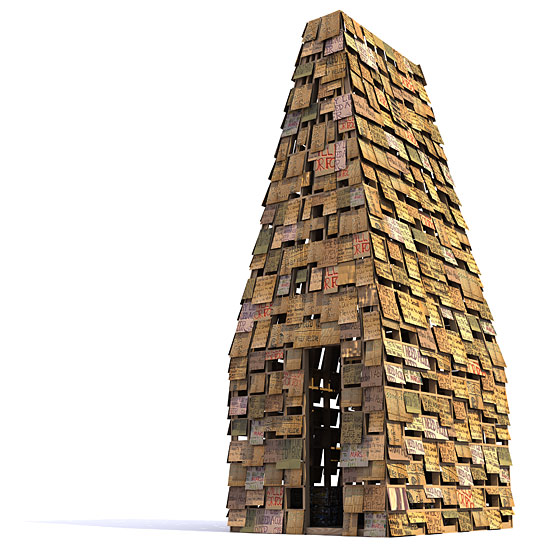 NY Times Magazine recently posted the 12 finalists in their modern sukkah design contest. While there were many beautiful entries, I especially like #8, "Sukkah of the Signs" by Ronald Rael and Virginia San Fratello of Oakland, California (check out the article for a larger shot). From the description of the project:
This reflects in several of the festival traditions, most notably living and dining in such a public space where any homeless people could see us and join us. Some temples also use it as an opportunity for a food drive, if they didn't just do one at Yom Kippur; one temple I belonged to collected fresh apples which were donated to a local food bank. I volunteered to transport them one year, and my car smelled like my favorite parts of fall for months afterward.
To me, a good modern Jewish observance combines a deep spiritual experience with an equally fervent effort to change our world for the better. I like this design for the highlighter it puts on homelessness. It puts the issue front and center; makes it unavoidable. There is a wonderful irony in sleeping in a home made of relics from the homeless; I would expect it to be a transformative experience for anyone that got the chance. If we slept here, we would spend the night considering the blessings that fill our lives, and return the next day to our homes filled with gratitude for all we have received. After that it would not be nearly so easy to turn a blind eye to the homeless people we pass on the street. Especially the ones holding the signs we ourselves might be sleeping under a year from now.
"It is traditional to eat and sleep in the sukkah for one week each fall, as a way of practicing a kind of ceremonial homelessness and empathizing with those who don’t have a roof over their heads. As a political statement, and as a way of transferring the prize money to those in need, Sukkah of the Signs is clad with cardboard signs purchased from destitute individuals across the country."This wasn't my favorite from an aesthetic point of view, but I love the story and message of it. As with all Jewish holidays, there exist a huge variety of explanations of the "meaning" of the festival, starting at the surface level as a harvest holiday and moving on to such ideas as reclaiming our history as a nomadic people, reflecting on the impermanence of all things, being reminded of the fragility of our physical world, being grateful for the houses we do have, and reconnecting with nature. (Sidenote: interesting how many of those ideas started with "re-" verbs. Appropriate as we're just past the beginning of the yearly holiday cycle!) Somewhere in many interpretations of the holiday, however, is the implication that, but for the grace of God, we would be homeless too. Whether metaphorically as a people, lost wandering in the desert, or literally as a family with no roof to sleep beneath.
This reflects in several of the festival traditions, most notably living and dining in such a public space where any homeless people could see us and join us. Some temples also use it as an opportunity for a food drive, if they didn't just do one at Yom Kippur; one temple I belonged to collected fresh apples which were donated to a local food bank. I volunteered to transport them one year, and my car smelled like my favorite parts of fall for months afterward.
To me, a good modern Jewish observance combines a deep spiritual experience with an equally fervent effort to change our world for the better. I like this design for the highlighter it puts on homelessness. It puts the issue front and center; makes it unavoidable. There is a wonderful irony in sleeping in a home made of relics from the homeless; I would expect it to be a transformative experience for anyone that got the chance. If we slept here, we would spend the night considering the blessings that fill our lives, and return the next day to our homes filled with gratitude for all we have received. After that it would not be nearly so easy to turn a blind eye to the homeless people we pass on the street. Especially the ones holding the signs we ourselves might be sleeping under a year from now.
Sunday, February 7, 2010
Reflecting on the Exodus
A few weeks ago we read about the Jews leaving Egypt, in a little preview of upcoming seders. Now we find them in the desert, beginning their wanderings. One of the perpetual questions this raises is why did God require us to spend so much time in the desert? Why forty years of suffering and toil? The past week gave me a new thought on the matter.
As some of you may know, I recently received some upsetting news. I was less than halfway into my week of mourning for it, a kind of self-reflective shiva, when I had to leave for Las Vegas for a week-long trade show; one of the largest in the world. I suppose I could make some Exodus-related joke about heading back into the land of the pyramids, but driving from LA to Vegas really confuses that into/out of the desert question.
I've gone to this tradeshow before; difference is, this year I hurt my ankle the weekend before, meaning I was attending the show with a walking cast and several medicines for the pain. And there was pain. That low-level constant type that you don't notice until it becomes a large all-encompassing one.
On the second day, I was walking back to my hotel (saying that the distance to my hotel was less than the length of the expo floor doesn't really say much) I realized I hadn't been thinking about my rejection letter at all; the pain was so great I had completely forgotten to suffer!
Now I'm sure my therapist will have a field day with that idea when I share it with her (I hear she's naming her second yacht after me), but I wondered if that same idea couldn't apply to the Israelites.
Think about it. The Exodus and that whole "slavery" thing were definitely a form of major psychic trauma; it's probably fair to say that modern psychologists meeting the wandering tribes would find more than a few cases of post-traumatic stress disorder. Even if they had gone straight to the Promised Land, they would not have been able to enjoy it. The pain was too much. So instead they go and wander around the Sahara until their feet are ready to fall off. I can personally attest that this is a wonderful distraction from those tiny, inconsequential emotional pains.
Granted, this is not exactly a kind and loving divine solution; it's literally the equivalent of a parent shooting their child's toe off to distract them from a bad breakup. But consider the context. God had several thousand PTSD patients on hand, and psychotherapy wouldn't be invented for several more millennia, assuming, to complicate the matter, that the Israelites could even survive long enough to become Freud's ancestors! The guy (God) had to work with what was available, and what he had was desert.
Honestly, by the time the Israelites finally got to sit down in the Promised Land and rest their feet, they were probably too tired to even care about Pharaoh What's-His-Name anymore.
As some of you may know, I recently received some upsetting news. I was less than halfway into my week of mourning for it, a kind of self-reflective shiva, when I had to leave for Las Vegas for a week-long trade show; one of the largest in the world. I suppose I could make some Exodus-related joke about heading back into the land of the pyramids, but driving from LA to Vegas really confuses that into/out of the desert question.
I've gone to this tradeshow before; difference is, this year I hurt my ankle the weekend before, meaning I was attending the show with a walking cast and several medicines for the pain. And there was pain. That low-level constant type that you don't notice until it becomes a large all-encompassing one.
On the second day, I was walking back to my hotel (saying that the distance to my hotel was less than the length of the expo floor doesn't really say much) I realized I hadn't been thinking about my rejection letter at all; the pain was so great I had completely forgotten to suffer!
Now I'm sure my therapist will have a field day with that idea when I share it with her (I hear she's naming her second yacht after me), but I wondered if that same idea couldn't apply to the Israelites.
Think about it. The Exodus and that whole "slavery" thing were definitely a form of major psychic trauma; it's probably fair to say that modern psychologists meeting the wandering tribes would find more than a few cases of post-traumatic stress disorder. Even if they had gone straight to the Promised Land, they would not have been able to enjoy it. The pain was too much. So instead they go and wander around the Sahara until their feet are ready to fall off. I can personally attest that this is a wonderful distraction from those tiny, inconsequential emotional pains.
Granted, this is not exactly a kind and loving divine solution; it's literally the equivalent of a parent shooting their child's toe off to distract them from a bad breakup. But consider the context. God had several thousand PTSD patients on hand, and psychotherapy wouldn't be invented for several more millennia, assuming, to complicate the matter, that the Israelites could even survive long enough to become Freud's ancestors! The guy (God) had to work with what was available, and what he had was desert.
Honestly, by the time the Israelites finally got to sit down in the Promised Land and rest their feet, they were probably too tired to even care about Pharaoh What's-His-Name anymore.
Thursday, December 31, 2009
100
It's been (slightly more than) one year and 100 posts. I would say that the experiment has been successful. I started this blog to get myself writing and thinking about Judaism from a variety of perspectives, styles, topics, and levels of quality.
Looking back at these first 100 posts, what have I learned?
It's hard to say something new about Judaism.
Seriously! I keep having these wildly radical ideas (compared to what I see around me), getting all excited about them, and telling my friends, only to have them say, "Oh, so you've been reading Rabbi so-and-so!" Or I'll crack open some history book and find that a few centuries ago this "radical idea" was considered passe and old fashioned.
What's a young Jew to do?
Also, I'm feeling my lack of knowledge. Granted, I'm not investing the amount of time in each post that many "serious bloggers" recommend, but I keep finding other bloggers, articles, etc. who bring so much more depth to their writing than I do. This is one of the major pieces I want to gain at school; the background and knowledge base that will allow me to support my writing with citations, references, and links that will make my writing stronger.
I don't write this post to be hard on myself; I'm very happy with what I've done this year, and like the way my writing is developing. Rather, I am acknowledging my awareness of my need for further development. On a larger scale, it has been an interesting reminder of the cyclical trends in human history. And, as humans, that applies to Jewish history as well.
My biggest revelation in this vein was realizing that what we now think of as "Traditional Judaism", and all of rabbinic Judaism for that matter, represented a huge divergence from the "original" Judaism. One writer suggested rabbinic Judaism could potentially be the single largest heresy in religious history!
When you look at it that way, it's not surprising I want to be one.
Thanks for reading; have a safe and happy new year, and see you all in 2010!

Looking back at these first 100 posts, what have I learned?
It's hard to say something new about Judaism.
Seriously! I keep having these wildly radical ideas (compared to what I see around me), getting all excited about them, and telling my friends, only to have them say, "Oh, so you've been reading Rabbi so-and-so!" Or I'll crack open some history book and find that a few centuries ago this "radical idea" was considered passe and old fashioned.
What's a young Jew to do?
Also, I'm feeling my lack of knowledge. Granted, I'm not investing the amount of time in each post that many "serious bloggers" recommend, but I keep finding other bloggers, articles, etc. who bring so much more depth to their writing than I do. This is one of the major pieces I want to gain at school; the background and knowledge base that will allow me to support my writing with citations, references, and links that will make my writing stronger.
I don't write this post to be hard on myself; I'm very happy with what I've done this year, and like the way my writing is developing. Rather, I am acknowledging my awareness of my need for further development. On a larger scale, it has been an interesting reminder of the cyclical trends in human history. And, as humans, that applies to Jewish history as well.
My biggest revelation in this vein was realizing that what we now think of as "Traditional Judaism", and all of rabbinic Judaism for that matter, represented a huge divergence from the "original" Judaism. One writer suggested rabbinic Judaism could potentially be the single largest heresy in religious history!
When you look at it that way, it's not surprising I want to be one.
Thanks for reading; have a safe and happy new year, and see you all in 2010!
Friday, December 25, 2009
For Those Observing Today...
Don't I wish...
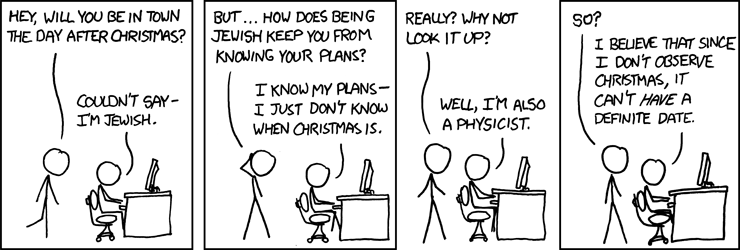
We celebrated The Annual Jewish Holiday today in the traditional way: we saw a movie and ordered Chinese food. My sister pointed out that the crowd at the movie theater when we got there, for the noon show, was mostly Jewish and immigrant families; when we left, it was almost all Christians. Must they steal all our traditions?
It's 5pm in Chicago now, meaning sunset was about three hours ago, so technically it's Day-After-Christmas Eve. We talked about "The Holidays" a lot this week, and I have a much longer post to write about the need to transition to a post-inclusive world, but for now I just want to say this: I have no objection to Christmas, I just feel frustrated, exhausted, and trapped because I can't get away from it without becoming a complete recluse for several weeks out of the year. I hope everyone who observes it has a happy, safe, healthy, and fun Christmas, but please remember that it's your holiday, not everyone's holiday, and the rest of us sometimes need a break.
We celebrated The Annual Jewish Holiday today in the traditional way: we saw a movie and ordered Chinese food. My sister pointed out that the crowd at the movie theater when we got there, for the noon show, was mostly Jewish and immigrant families; when we left, it was almost all Christians. Must they steal all our traditions?
It's 5pm in Chicago now, meaning sunset was about three hours ago, so technically it's Day-After-Christmas Eve. We talked about "The Holidays" a lot this week, and I have a much longer post to write about the need to transition to a post-inclusive world, but for now I just want to say this: I have no objection to Christmas, I just feel frustrated, exhausted, and trapped because I can't get away from it without becoming a complete recluse for several weeks out of the year. I hope everyone who observes it has a happy, safe, healthy, and fun Christmas, but please remember that it's your holiday, not everyone's holiday, and the rest of us sometimes need a break.
Friday, December 18, 2009
Loyalties Divided?
I wrote this post, originally, on my smart phone. Once I got into the tiny-typing vibe, it went very smoothly and beyond all expectations it wound up being a rather lengthy post. One of my better ones, I feel, drawing in talmudic analysis, US law, and excellent use of Jefferson Starship lyrics.
Turns out the "save" feature does not work automatically on my phone, so I must now take the following steps, in order:
1. Rewrite the post.
2. Locate my hammer.
3. Purchase a new cell phone.
The reconstructed post will be much shorter, since most of the original passionate inspiration has faded and I am working from memory rather than notes.
The question is this: at many "official" American Jewish events, especially school and camp events, we open with the Star Spangled Banner, followed by Hatikvah; should we continue to do this?
One of the classic tropes of antisemitism is that Jews can never be real Americans, Frenchmen, Italians, Germans, Russians, Greeks, Romans, Brits, etc. is that they hold a "secret loyalty" to another nation, the "Jewish nation", and therefore can never be fully trusted in our own. In opening all major Jewish events with Hatikvah, we provide some small measure of truth for this calumny to work with.
I understand, or think I understand, the underlying motivation. Israel is a strong part of American Jewish identity, especially after the wars of the 60's and 70's. Singing Hatikvah is a show of solidarity with and love for Israel. But singing a nation's anthem is more than that. Singing the anthem, to a flag no less, is a declaration of loyalty. Look at Olympic athletes; the medalists sing their own anthem but not the others. Many times this is probably because they only know their own anthem, but what about the international NBA players; surely they know the US anthem in addition to their own? What about Jewish athletes from anywhere around the world? It would be regarded as highly inappropriate for these athletes, as representatives of their nation, to sing the anthem of another country.
Imagine how this would play out in a presidential campaign. If it got out that a Jewish presidential candidate (suspend disbelief for the duration of this argument and pretend there could be such a thing) regularly sang the Israeli anthem, it would end the campaign! Don't believe me? Imagine if it were a Muslim candidate singing the anthem of Saudi Arabia or Iran.
I do not mean to suggest public opinion should be the guide for our actions, and creating traditions out of fear of possible antisemitism has already damaged our religion enough. But we are now at a point where we can, and should, consider this particular tradition and reevaluate its place in our culture. I love singing Hatikvah; it always fills me with a sense of pride. But isn't that part of the problem?
And now, if you will excuse me, in the spirit of holidays recently passed, I will emulate Judah Maccabee to my cell phone's Antiochus.
Turns out the "save" feature does not work automatically on my phone, so I must now take the following steps, in order:
1. Rewrite the post.
2. Locate my hammer.
3. Purchase a new cell phone.
The reconstructed post will be much shorter, since most of the original passionate inspiration has faded and I am working from memory rather than notes.
The question is this: at many "official" American Jewish events, especially school and camp events, we open with the Star Spangled Banner, followed by Hatikvah; should we continue to do this?
One of the classic tropes of antisemitism is that Jews can never be real Americans, Frenchmen, Italians, Germans, Russians, Greeks, Romans, Brits, etc. is that they hold a "secret loyalty" to another nation, the "Jewish nation", and therefore can never be fully trusted in our own. In opening all major Jewish events with Hatikvah, we provide some small measure of truth for this calumny to work with.
I understand, or think I understand, the underlying motivation. Israel is a strong part of American Jewish identity, especially after the wars of the 60's and 70's. Singing Hatikvah is a show of solidarity with and love for Israel. But singing a nation's anthem is more than that. Singing the anthem, to a flag no less, is a declaration of loyalty. Look at Olympic athletes; the medalists sing their own anthem but not the others. Many times this is probably because they only know their own anthem, but what about the international NBA players; surely they know the US anthem in addition to their own? What about Jewish athletes from anywhere around the world? It would be regarded as highly inappropriate for these athletes, as representatives of their nation, to sing the anthem of another country.
Imagine how this would play out in a presidential campaign. If it got out that a Jewish presidential candidate (suspend disbelief for the duration of this argument and pretend there could be such a thing) regularly sang the Israeli anthem, it would end the campaign! Don't believe me? Imagine if it were a Muslim candidate singing the anthem of Saudi Arabia or Iran.
I do not mean to suggest public opinion should be the guide for our actions, and creating traditions out of fear of possible antisemitism has already damaged our religion enough. But we are now at a point where we can, and should, consider this particular tradition and reevaluate its place in our culture. I love singing Hatikvah; it always fills me with a sense of pride. But isn't that part of the problem?
And now, if you will excuse me, in the spirit of holidays recently passed, I will emulate Judah Maccabee to my cell phone's Antiochus.
Wednesday, December 9, 2009
Oy Hanukkah, Oy Hanukkah.
I wish there was something new to say about the whole "Winter Holiday" season of joy and stress, but it's all really well-tread territory. My struggle with Christmas growing up was hardly unique; different, yes, but only in details. The core story is one most Jewish kids would recognize. And, I'm sure, quite a few non-Christians of any stripe.
I saw this story on the God Blog today. To sum up: the Obama administration briefly considered not displaying a Christmas creche; the "community of social secretaries" - seriously - found out about this, and "emitted a collective gasp". This gasp was apparently a strong enough statement of public outcry that the White House will, you'll be glad to know, be displaying the creche.
I know there's a lot of gray area about what can be show without denoting religious bias, and frankly I guess I don't care too much about this one - slightly tacky - decoration. It was really the end of the article that got me.
I saw this story on the God Blog today. To sum up: the Obama administration briefly considered not displaying a Christmas creche; the "community of social secretaries" - seriously - found out about this, and "emitted a collective gasp". This gasp was apparently a strong enough statement of public outcry that the White House will, you'll be glad to know, be displaying the creche.
I know there's a lot of gray area about what can be show without denoting religious bias, and frankly I guess I don't care too much about this one - slightly tacky - decoration. It was really the end of the article that got me.

I don't know what it was about this passage, but it left me feeling...betrayed. Or maybe it's more accurate to say "sold out". Like Team Obama said, "We know this might bother you, buddy, but we're going to do it anyway because it could gain us a few points in the polls". I know that's the core of politics...this one just felt personal.Let me give another hat tip here to my friend Eric Metaxas, who, as a former editor of The Record at Yale University, knows a few things about satire, politics and culture. He is also the author of “Everything You Always Wanted to Know About God (but were afraid to ask)” and a bunch of other books. In his commentary at the Fox News website, Metaxas noted:
If President Obama wanted to fuel the fears of every serious Christian in America and actually prove that he is every bad thing they’ve ever heard about him on every crazy Web site, the idea of symbolically taking Jesus out of the White House at Christmas would be just the ticket! Let’s face it: “Brand Obama” dodged a bullet by not going forward with this terrible idea, but only barely dodged it. After all, the facts of the story are right there in The New York Times for all to see.
Amen. A highly symbolic close call, for Obama and other Democrats who want to stay in touch with ordinary American who frequent mainstream church pews.
Tuesday, December 1, 2009
Holidays, Happy and Otherwise
Hi all,
So last week was an exiting and interesting week. This is the first "Holiday Season" with my girlfriend. We spent Thanksgiving morning with my family, and did dinner with some of her friends. Fun, and we got through both parties without serious incident.
It was hard to get into the spirit, though. We started the holiday with tragedy. Wednesday night my girlfriend's 14 year old cat finally lost his battle with diabetes. We took him to a nearby 24-hour animal hospital, said our goodbyes, and the vet gave him the shot. I held my girlfriend tight, we said kaddish, and went home to try to sleep and get ready for celebrations the next day.
It's strange watching someone you love grieve. Seeing them overcome by emotions so powerful, and knowing all you can do is hold them and watch. Having to keep your own grief in check because someone needs to sign the papers and drive the car, and because yours is such a small, pale thing in comparison.
There's so much more I want to say, about grief and about relationships and about the empty space in our apartment. It's still a bit too raw though.
So last week was an exiting and interesting week. This is the first "Holiday Season" with my girlfriend. We spent Thanksgiving morning with my family, and did dinner with some of her friends. Fun, and we got through both parties without serious incident.
It was hard to get into the spirit, though. We started the holiday with tragedy. Wednesday night my girlfriend's 14 year old cat finally lost his battle with diabetes. We took him to a nearby 24-hour animal hospital, said our goodbyes, and the vet gave him the shot. I held my girlfriend tight, we said kaddish, and went home to try to sleep and get ready for celebrations the next day.
It's strange watching someone you love grieve. Seeing them overcome by emotions so powerful, and knowing all you can do is hold them and watch. Having to keep your own grief in check because someone needs to sign the papers and drive the car, and because yours is such a small, pale thing in comparison.
There's so much more I want to say, about grief and about relationships and about the empty space in our apartment. It's still a bit too raw though.
Wednesday, November 18, 2009
Five Reasons Vampires Aren't Jews
As part of the Jewish Journal thumbing its nose (biting its thumb?) at the new Twilight movie (deservedly) Rabbi Wolpe details five important differences between Jews and vampires.
I greatly enjoyed this essay, especially as a horror and folklore aficionado who enjoys tracing monster legends back to the real-life fears that spawned them, but find one line particularly troubling:
I sincerely hope not. I doubt that his claim is accurate; it's possible he spoke metaphorically there. Weddings, childbirth, b'nei mitzvot...all of these are life-based. Many of our holidays originate in death and tragedy, but the celebration is that we're still alive!
Granted, there is the mirror argument-by-definition; celebrating life must also celebrate death, even if indirectly, because death is the line that defines life. We celebrate at Hannukah and Purim because we survived; we are still alive. Weddings are celebrations precisely because our time together in this life is so brief. New children are welcomed because they add new sparks to the fire of life, providing heat and light against the cold and dark of death. From that perspective, yes, all of Jewish ritual is about death.
I always looked at it the other way around. As a child I did see Jewish ritual as death obsessed. There are laws about mourning? We are required to behave a certain way and grieve for a certain amount of time? How morbid! And the prayers in every service, reminding us of the dead? As I grew and studied, though, I realized that these laws actually encourage us to focus on the living. By strictly defining when, where, and how to mourn, it tells us the rest of our time is dedicated to life.
Someone important to you dies? Take the next 30 days, go feel really miserable. Trust me; you'll need it. After that, spend a few more months feeling slightly miserable, and the rest of the year feeling just generally sad. Then, each year after that, pick one day to go get really stinking sad about their absence. Then get up, dust yourself off, and get on with life.
The laws of mourning don't turn our focus to death; that happens naturally. The rituals turn us back towards life.
And at any rate, compared to most - if not all - the world's other major religions, our death and afterlife focus is so small as to be negligible.
Their day begins at night, they show a certain aversion to the sign of the cross and they dress in black. Of course, I am talking about Jews.Of course not. He explains why, insightfully and entertainingly, before concluding, "Vampires are not Jews. Maybe we can allow one powerful, popular trend to be about someone else for a change?"
But add some invidious stereotypes — bloodsucking and a predatory nature, and you get vampires. So, are vampires Jewish?
I greatly enjoyed this essay, especially as a horror and folklore aficionado who enjoys tracing monster legends back to the real-life fears that spawned them, but find one line particularly troubling:
Judaism believes in death. Yes, it believes in immortal life, but death comes first. The entirety of Jewish ritual is crafted to emphasize that all creatures — all of them — ultimately, unequivocally die.The ENTIRETY of Jewish ritual? I get and agree with the belief in mortality, in fact I frequently accuse modern Judaism of being too death-centric, a religion stuck in mourning, but ALL ritual?
I sincerely hope not. I doubt that his claim is accurate; it's possible he spoke metaphorically there. Weddings, childbirth, b'nei mitzvot...all of these are life-based. Many of our holidays originate in death and tragedy, but the celebration is that we're still alive!
Granted, there is the mirror argument-by-definition; celebrating life must also celebrate death, even if indirectly, because death is the line that defines life. We celebrate at Hannukah and Purim because we survived; we are still alive. Weddings are celebrations precisely because our time together in this life is so brief. New children are welcomed because they add new sparks to the fire of life, providing heat and light against the cold and dark of death. From that perspective, yes, all of Jewish ritual is about death.
I always looked at it the other way around. As a child I did see Jewish ritual as death obsessed. There are laws about mourning? We are required to behave a certain way and grieve for a certain amount of time? How morbid! And the prayers in every service, reminding us of the dead? As I grew and studied, though, I realized that these laws actually encourage us to focus on the living. By strictly defining when, where, and how to mourn, it tells us the rest of our time is dedicated to life.
Someone important to you dies? Take the next 30 days, go feel really miserable. Trust me; you'll need it. After that, spend a few more months feeling slightly miserable, and the rest of the year feeling just generally sad. Then, each year after that, pick one day to go get really stinking sad about their absence. Then get up, dust yourself off, and get on with life.
The laws of mourning don't turn our focus to death; that happens naturally. The rituals turn us back towards life.
And at any rate, compared to most - if not all - the world's other major religions, our death and afterlife focus is so small as to be negligible.
Monday, September 28, 2009
The Other Dayenu
"Is such the fast I desire,
A day for men to starve their bodies?
Is it bowing the head like a bulrush
And lying in sackcloth and ashes?
Do you call that a fast,
A day when the Lord is favorable?"
You listen to the sermons and read the haftarah and feel good about yourself. You talk about the homeless, as if it were enough.
As if it were enough to talk about the homeless, but not see them in your streets.
As if it were enough to see them in your streets, but not feed them.
As if it were enough to feed them, but not shelter them.
As if it were enough to shelter them, but not clothe them.
As if it were enough to clothe them, but not give them medical care.
As if it were enough to give them medical care, but not educate their children.
As if it were enough to educate their children, but not welcome them to your society.
As if it were enough to welcome them to your society, but not love them as yourself.
Saturday, September 19, 2009
5770!
A thought from last night:
We read the line "Renew our days as in the past", but the Hebrew word used comes from חדש, meaning "new". So really what we're getting, as our choir director put it, is not Renewal but Newal.
May this coming year be fresh and new; a year of joy, a year of healing, a year of learning, a year of life.
L'shana Tovah!
We read the line "Renew our days as in the past", but the Hebrew word used comes from חדש, meaning "new". So really what we're getting, as our choir director put it, is not Renewal but Newal.
May this coming year be fresh and new; a year of joy, a year of healing, a year of learning, a year of life.
L'shana Tovah!
Subscribe to:
Posts (Atom)